Designing Distributed Systems: The First Four Chapters
Brendan Burns opens Designing Distributed Systems with a useful premise: distributed systems become easier to reason about when we give recurring solutions names. The first chapter establishes that pattern language; the next three make it concrete with small, reusable containers that support an application without becoming part of its business logic.
Sidecar
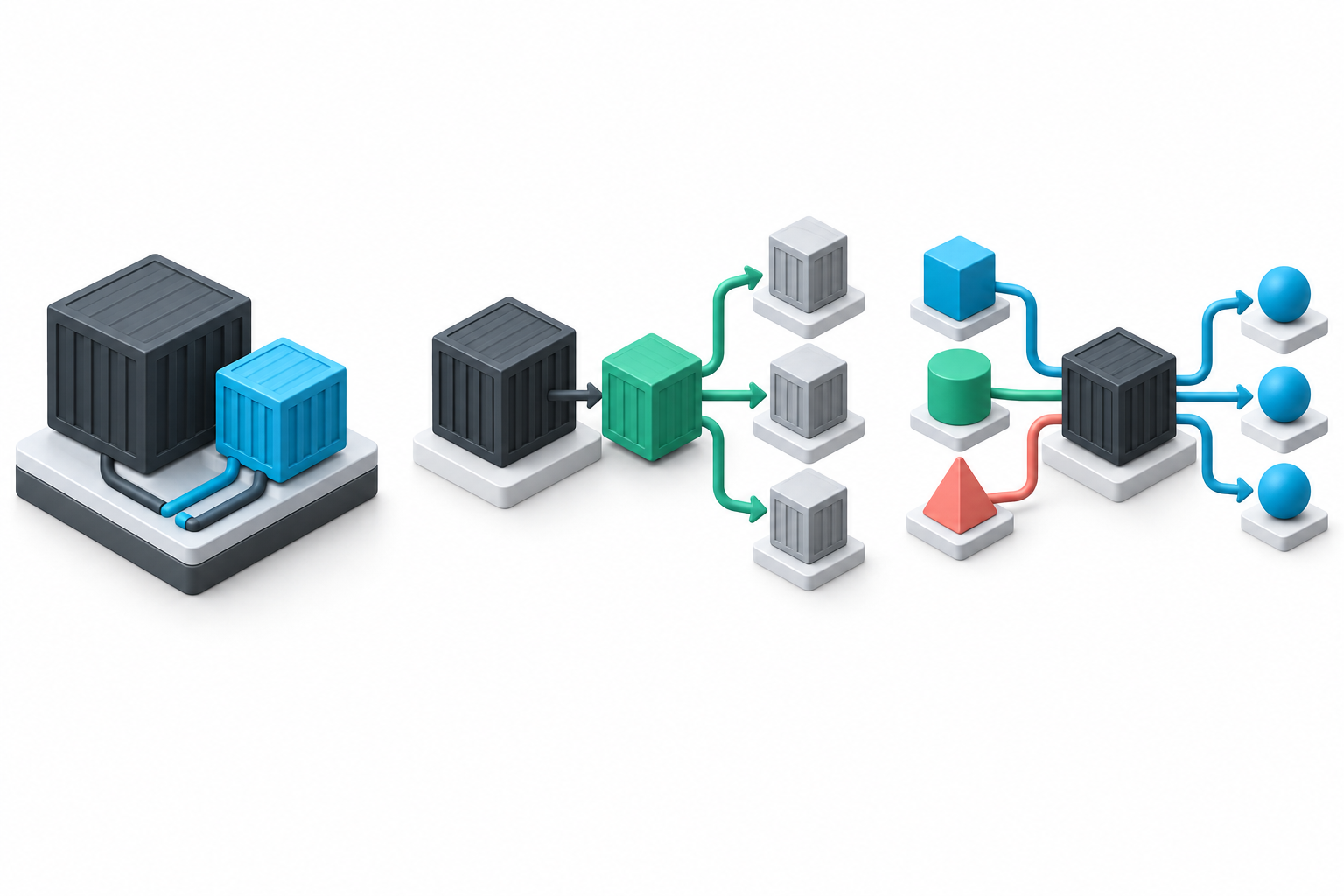
A sidecar extends an application from beside it. Both containers share a lifecycle and local resources, but remain independently built and maintained. Think HTTPS termination, configuration sync, or log collection.
flowchart LR
    Client[Client] --> Pod
    subgraph Pod[Pod / Host]
        App[Application]
        Sidecar[Sidecar<br/>HTTPS, config, logs]
        App <--> Sidecar
        App --- Shared[(Shared files / network)]
        Sidecar --- Shared
    end
My take: This is the foundation of the book. It is simple, visual, and immediately useful. The danger is turning every small concern into another container and making the pod harder to operate than the application.
Ambassador
An ambassador is a local representative for a remote service. The application talks to a simple local endpoint; the ambassador owns routing, retries, sharding, discovery, or experiment splitting.
flowchart LR
    subgraph Pod[Pod / Host]
        App[Application] -->|localhost| Ambassador[Ambassador<br/>routing, retries, sharding]
    end
    Ambassador --> A[Service A]
    Ambassador --> B[Service B]
    Ambassador --> C[Service C]
My take: The pattern keeps infrastructure knowledge out of application code. It is especially convincing when several applications need the same connection behavior. It also creates one more network hop and one more place to debug.
Adapter
An adapter faces the opposite direction: it translates an application’s output into the interface the outside world expects. Different applications can expose one standard shape for metrics, logs, or health.
flowchart LR
    subgraph Pod[Pod / Host]
        App[Application<br/>custom output] --> Adapter[Adapter<br/>normalize]
    end
    Adapter --> Metrics[Standard metrics]
    Adapter --> Logs[Standard logs]
    Adapter --> Health[Standard health API]
My take: Adapter is the least glamorous and perhaps the most practical pattern here. Standardizing at the boundary lets old and new services participate in the same operational system without invasive rewrites.
Verdict
These chapters are short, concrete, and worth reading together. Sidecar adds capability, Ambassador simplifies outbound communication, and Adapter normalizes what comes out. The larger lesson is not “use more containers.” It is to isolate reusable concerns behind small, explicit interfaces.
The diagrams are the memory aid; the pattern names are the shared vocabulary.